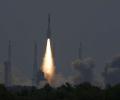
The Indian Space Research Organisation (ISRO) on Monday successfully launched a second generation navigation satellite, using a GSLV rocket with a cryogenic upper stage to do the job.

NavIC is India's independent, standalone navigation satellite system aimed at providing position, navigation and timing (PNT) services across India and around 1,500 km beyond the country's landmass.
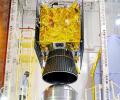
India successfully launched IRNSS 1C on board ISRO's PSLV C26 rocket from the spaceport at 1.32 am on Thursday, moving a step closer to setting up the country's own navigation system on par with Global Positioning System of the US.

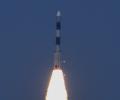
In a landmark late Monday night journey into a new era of space application, India successfully launched its first dedicated navigation satellite using the Polar Satellite Launch Vehicle which blasted off from the Satish Dhawan Space Centre.

India is on the verge of entering 'big league' in the world aviation scene with the launch of satellite-based navigation system, GAGAN, next year, Civil Aviation Minister Praful Patel said on Tuesday.

In a textbook mission, ISRO's PSLV-C32 lifted off from Sriharikota and later injected the IRNSS-IF in sub-Geosynchronous Transfer Orbit.
Prime Minister Narendra Modi lauded the scientists saying, "with this successful launch, we will determine our own paths powered by our technology".

The Indian Space Research Organisation successfully launched India's fifth navigation satellite IRNSS-1E from Sriharikota.

The Commission for Air Quality Management (CAQM) has directed Punjab, Haryana, Uttar Pradesh, and Rajasthan to implement drone-based surveillance to monitor and prevent stubble burning. This initiative aims to counter late-evening burning incidents that evade satellite detection, leveraging drone technology for real-time monitoring, accurate detection, and evidence collection to ensure effective enforcement against agricultural residue burning.

The Indian government has initiated the process of procuring All-Terrain Vehicles (ATVs) for deployment along the northern borders for the Indian Army. The Ministry of Defence has issued a Request for Information (RFI) seeking vendors who can supply the vehicles. The RFI outlines operational and technical specifications for the ATVs, including a minimum seating capacity of four personnel, disc brakes, automatic transmission, and heliportability by Chinook/Mi26 helicopters.
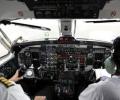
Aviation watchdog DGCA has issued a circular to airlines and the Airports Authority of India (AAI) on measures to deal with threats from jamming and spoofing of the Global Navigation Satellite System (GNSS) amid reports of such interference in the Middle East.

GPS spoofing occurs when fake satellite signals are transmitted to an aircraft's navigation system, confusing pilots or onboard systems about the plane's actual position or altitude. Such false signals pose a serious safety risk, especially during landing.

'From day one, our vision has been to build a company that develops and owns the technologies defining the future of space.'
The Indira Gandhi International Airport in the national capital is the country's busiest airport and RWY refers to runway.

Prime Minister Narendra Modi addressed the ASEAN-India summit, advocating for a free, inclusive, and rules-based Indo-Pacific based on cooperation. He proposed nine initiatives, including a long-term maritime plan, free e-visas, and cooperation in civil nuclear energy, emphasizing India's commitment to ASEAN's unity and centrality amidst global uncertainties.
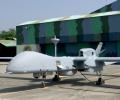
The Indian government is planning to develop an unmanned combat search and rescue aircraft for the Indian Air Force, designed to operate autonomously and in challenging terrains.

Under the new regulations, known as the National Highways Fee (Determination of Rates and Collection) Amendment Rules, 2024, fees will now be charged on the actual distance travelled if the distance exceeds 20 kilometres.
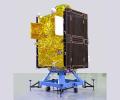
The need for NavIC was cemented after India was denied access to crucial navigation data from global providers during the 1999 Kargil War.
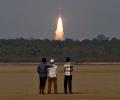
'The goal seems to be that we do not invest further in our system to make our system more accurate and more reliable or more global in reach,' an ISRO source tells Shivanand Kanavi.
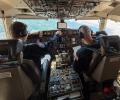
In recent times, there have also been instances of GPS spoofing and interference incidents at Delhi, Mumbai, Kolkata, Amritsar, Hyderabad, Bangalore and Chennai airports.

Skyroot Aerospace successfully launched India's first privately developed orbital rocket, Vikram-1, placing multiple technology demonstration payloads and commemorative items, including a postcard from Prime Minister Narendra Modi, into low Earth orbit, marking a significant entry into the global orbital launch market.

NavIC consists of a constellation of seven satellites and a network of ground stations and is touted to be more accurate than GPS.

Weighing 6,100 kg, the communication satellite would be the heaviest payload to be placed into the Low Earth Orbit (LEO) in LVM3 launch history from Indian soil.
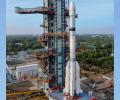
At 6.23 am on 29.1.2025, the 50.9 metre tall and weighing 420.7 ton Geosynchronous Satellite Launch Vehicle-F15 (GSLV-F15) is slated to blast off from the second launch pad carrying the 2,250 kg NVS-02 navigation satellite.

India is making a significant push to establish itself as a global semiconductor manufacturing hub, driven by strategic investments and policy support. The upcoming SEMICON India 2026 event will showcase the country's advancements and ambitions in this critical industry, which underpins virtually all modern electronic devices and has faced global supply chain vulnerabilities.
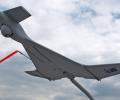
The Israeli-made Harop drone is a powerful weapon that can operate silently in enemy territory and carry a significant payload.

The appointment comes as Agnikul prepares for Mission 02, a flight that will attempt, for the first time on Indian soil, the recovery of an orbital-class rocket booster and the extension of a rocket's upper stage into an on-orbit platform.
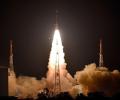
"I am really grateful to the entire ISRO family for having worked this hard and making IRNSS-1I a success," said the space centre's chief K Sivan.

The US blockade on Iranian ports is aimed to curb Iranian energy exports, thereby crippling its economy to force Iran back to the negotiating table, points out Commodore Venugopal Menon (retd).

Scientists discover tiny whirlpool-like swirls on the Sun that could explain solar activity, improve space weather research and solve a decades-old solar mystery.

Aeron Systems, founded in 2008 by Ashvani Shukla and Abhijit Bokil, is looking to contribute to programmes such as the Tejas light combat aircraft

Google Glass may face some tough competition from a San Francisco-based company which plans to develop smart Bluetooth-enabled glasses that display HD video and are equipped with a global navigation satellite system.

TARA is India's first indigenous modular glide weapon, capable of transforming conventional unguided warheads into long-range precision-guided weapons.
'We won not (only) because we were able to carry out long-range precision strikes.' 'That is, of course, one of the reasons but we had better situational awareness about what's happening than Pakistan.'

The launch of IRNSS IC, the third of seven satellites in the series to put in place India's navigation system at par with US' Global Positioning System, that was deferred following a technical snag has been rescheduled for October 16.
In order to have protection against drone attacks, all the three defence forces including the Army, Navy and Air Force have signed contracts for acquiring DRDO-developed anti-drone systems.

A sovereign cloud, our own DNS root and Root CA, a defence-led research base that builds for keeps, and a real national cybersecurity strategy that outlives electoral cycles are not vanity projects. They are the difference between a nation that can be switched off and one that cannot, points out Venkata Satish Guttula.
India will develop its own version of the Global Positioning System by launching seven satellites in 6 years. The Indian Regional Navigation Satellite System, to be functional by 2012, will be used for surveillance, telecommunications, transport etc.

India is set to take its first steps towards its own human space flight when the uncrewed Gaganyaan mission soars to the skies later this year. Private players in the space sector are also gearing up for launching satellites on home-built rockets.

'This policy is a vision to position Karnataka as the epicentre of India's space ambitions'
